Introduction

webrose.JPG

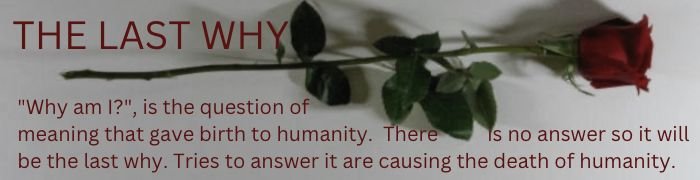
Troubled by the conflict dominating our lives I asked why? The answer is a question of meaning I present in "the poem", "the precis", "the essay" all titled "The Last Why". The other writings are derivatives. Thank you for sharing. Doug.E.Barr  

my poetry, in a poem

Twitter
links


squarespace-powered-button.png


Follow DougEBarr on Twitter 


Owner Login
Main
Thursday
Jun232005

The Last Why: the poem

The 1800 word explanation of what's happening.

Introduction 1-4
Our Nature introduction
5-6
Our body/mind/
spirit 7-10
Our reactions to the void introduction
11-12
The ideal 13-24
The absolutely restrictive (trying to fill the void) 25-37
The absolutely permissive (giving up) 38-39
Blends introduction 40-42
Consequences of blends 43-56
Conclusion 57-70

***

O Lord what fools we tend to be.
The facts of life we do not see.
In zones of rights each one resides,
When in real life there are no sides. 1

We’re blinded by our sense of rights
That justifies our deadly fights
Which end it should be plain to see
With one left standing; it is me. 2

What is the point? We must ask, “why?”
When we’re alone who’ll hear our cry?
We need each other to survive.
“We” is the state to feel alive. 3

God knows our rights of self are wrong
But cannot modify our song.
Together we must change our tune,
For if we don’t it will end soon. 4

***

There will be doubt that we can change.
Our choice of ‘notes’ yields such a range;
But harmony is not for dreams.
It is within “Our Law” it seems. 5

Our bodies, minds are all the same
Within new meaning for each name.
Our spirit can leave us all buoyed.
Then, our reactions to the void. 6

***

Our bodies have three sides in one.
They're all the same integration
Of realized capacity,
And knowledge and activity. 7

Our minds are too, three sides in one.
They're all the same integration
Of realized capacity,
And knowledge and activity. 8

Regarding every body/mind,
The structure’s sizes we will find
Unique, but they’re identically
Joined shapes with equal sides of three. 9

In life our spirit is our light.
It's range can be from dim to bright.
With body/mind it too resides.
The third of all four equal sides. 10

***

The fourth, we to the void react.
The void’s existence is a fact.
A missing fact we can’t deny,
We find it asking the last “why?” 11

The evidence of our life says
We can react in different ways;
But when unique we cannot be
Our individuality. 12

***

Reactions blend two out of three.
The first is from biology.
"Ideal", it's how we came about
In general, it’s “reaching out….”13

To ends of our capacity,
To others who we need, to be,
And making life’s ideal tripod
We naturally reach out to God. 14

This natural activity
Is hard; but living it can be
The only way that we can feel
Innate ‘rewards’ which make life real. 15

It’s hard since there's no written 'light',
Just faith and hope that it is right.
Then there’s responsibility
To God, to others and to 'me'. 16

A sensitivity we need
To God’s spirit and too indeed
To that of others and our own.
Then there’s the caring we must hone. 17

When facing what we cannot see,
The courage we must have, to be.
To see life’s end we have to wait.
Alone, we must self-motivate. 18

Although the hardest of the three
Ideal rewards we all shall see.
There’ll be our spirit shining bright
Allowing us to feel the ‘light’. 19

We’ll feel control, we’ll also sense
Our ‘strings’ knot free, ideally tense.
Frustration, pace and urgency
Three others optimum will be. 20

A freedom by the ideal bound,
Fulfillment, satisfaction found.
Self-worth, pleasure, joy, elation,
Excitement, anticipation, 21

Security and happiness
Reward as well, ideal success.
Then too when living the ideal
Faith justified we all will feel. 22

Among the last we’ll also find
A purpose, meaning, peace of mind,
Unending love; hope from it springs.
Rewards to all, the ideal brings. 23

Subjective though rewards may seem
The fact is they are not a dream.
The ideal message that they send,
Self-realization is the end. 24

***

The next reaction we can’t live.
It’s absolutely restrictive.
Our death it guarantees yet still
We try in vain the void to fill. 25

Meaning to life we try to give.
We think this is the way to live.
Though one, to ‘see’ it I must state
Within the one I’ve gathered eight. 26

The first of eight a name I call
Religious/philosophical.
With answers to the question “Why?”
In vain to fill the void we try. 27

A materialistic one
Gives us a task that can’t be done.
It matters not how much we spend
To fill the void; it will not end. 28

In romantic ones we'll find
Supporting notions which are blind.
Love of another we can 'see’
Will never fill the void in ‘me’. 29

With our reaction factual
The void within we can't keep full
Of all the facts we know combined
Nor with key facts we think we'll find. 30

The void we also try to fill
With family but never will.
It matters not the family
The emptiness will always be. 31

If occupational we choose,
The fight to fill the void we'll lose. 
Careers and jobs we think we need
To fill our life will not succeed. 32

We strive to gain pre-eminence.
Another one of our attempts
To fill the void will also fail
Regardless of the peaks we scale. 33

The eighth reaction we can pick,
 The multi-part anesthetic.
With fixes such as drugs and sex
We fill the void with no effects. 34

It matters not the ways we choose.
We will not their description lose
By recombining into one
This end restrictive reaction. 35

Anti ideal in most respects
Are its demands and known effects.
Just where rewards were optimum
Are punishments their maximum. 36

Activity unnatural
Is trying thus the void to fill.
Resulting from this reaction
Is our active self-destruction. 37

***

The last of three we too can’t live.
It’s absolutely permissive.
It’s giving up so we can’t see
The deadly inactivity. 38

Rewards we find in the ideal,
None in this absolute we’ll feel.
The dead end of this inaction
Is our passive self-destruction. 39

***

See each reaction as a thread.
With no ideal we would be dead.
So it must be part of the blend.
The other part is either end. 40

The blends form a continuum
That of reactions is the sum.
From restrictive to permissive,
Are the reactions we can live. 41

Midway between is the ideal.
To either side life is less real.
The more permissive we can leave.
The more restrictive tints our weave. 42

***

With eight coloured, the ideal clear,
We weave the ‘fabrics’ we hold dear.
Although we weave unique attempts
We can predict the consequence. 43

The ideal weave we can not see.
It’s natural activity.
As coloured threads we add to it,
We lose the clearness bit by bit. 44

There is a limit weight and so
When threads we add then some must go.
That’s how the ideal we could live
Becomes one hue, most restrictive. 45

When down from the ideal we slide
Into the more restrictive side,
Our ‘fabrics’ lose their naturalness
While gaining more restrictiveness. 46

From reaching out in the ideal
We focus more on what’s less real.
To halfway we see one to eight.
From there, down to the single state. 47

We reach to God for a hand up
To natural acts that fill our ‘cup’.
We beg from God but are annoyed
There’re no hand-outs to fill the void. 48

God fills one third of the ideal.
When "reaching..." out then God we’ll feel.
God isn't in religious thread.
When wound up in it God is dead. 49

We blend some of these two and get
Reactions that make up a set.
How far we are from the ideal
Dictates amounts of each we feel.
. 50

Our knowledge is the facts we seize
While “reaching…” to capacities.
When gathered just the void to fill
The facts become unnatural. 51

From the ideal to restrictive
Facts change from those we need to live
To those of which it can be said
Are all the ones that leave us dead. 52

The ideal, in us love creates.
With less ideal, love's loss dictates.
One living at the restrictive
Consumes all the love we can give. 53

Our only right is reaching out
Despite the evidence about
That shows us clinging to our song
We think all right but is part wrong. 54

We think we’re right throughout the range
Though the amounts of each thread change,
For while the ideal will decrease
Our sense of right will never cease. 55

The consequences we last feel
In our reactions more unreal;
Rewards decreasing, complements
  The ever growing punishments. 56

***

Our ‘fabrics’ are collectively
The ‘fabric’ of humanity.
It is a ragged, colored hash.
Our actions with all others clash . 57

We battle for we’re all the same
Though differences we give the blame.
We see the similarity
In where we point activity. 58

Activity that’s natural
Directs us on lines parallel
To others, our capacity
And out to God, the ideal three. 59

Unnatural activity
Is all directed inwardly
Toward the void we have within,
Opposed to others’ direction. 60

Whatever threads, it matters not
A different weave that we’ve all got.
It is inward direction picked
That puts us all into conflict. 61

Now getting back to our self-rights
That generate our “deadly fights”,
It’s human rights philosophy
That makes most conflict that we see. 62

There is for sure some other thread
In the life ‘fabric’ that we spread.
But in it is our right we say,
To fill the void in our own way. 63

As long as we defend these rights
We will continue with our fights.
By adding more “rights” thread to it
  Our conflict will grow bit by bit. 64

And even with the status quo
There is no other place to go
But to the self-destructive end.
  Our conflict proves this is the trend. 65

The action that we need to take
In which we all must have a stake,
Is adding clear thread to our weave,
A choice that we just cannot leave. 66

With choices made we will begin
To see a change that starts within.
From self-destruction we will turn
As ways of the ideal we learn. 67

We’ll sense the punishments abate.
For one, we will no longer hate;
And though the void will not be filled,
Ideal rewards will leave us thrilled. 68

In this "real life" no sides there’ll be.
We all will live in harmony.
Our life lines individual
Will not cross running parallel. 69

If  "Our Law” states what we’ll become,
We could add up to just one ‘sum’.
We might then find when in our place
Together we reflect God’s face. 70

*****


Reader Comments (11)

Wow, Doug! Beautifully thought out and neat to read. You are quite prolific in your ideas and expressing them and I have really enjoyed seeing your website and will return to it again and again! I, too, was born in 1947 and have my 89 yo Mother living with me. However, we lost her in 1998 to dementia and it continues, but with help from a daily sitter, it is manageable and I am so thankful she does not have to be institutionalized. Having her around is a blessing. I write poetry, too and have since 1961. In fact, I found your website while looking up something on Edgar Lee Masters! Where is your home? It is beautiful and I love your gardens and what you said about the stone wall you were building being the only kind of wall we should build! Well said. Also, I agree the white flower which you did not recognize is some type of Iris...English, Siberian....one of the foreign irises! Take care and keep up the great work. It is refreshing to know you. Glad you have shared it all. May God continue blessing you.
Regards to a fellow boomer enjoying life in search of the last why! Gail

----------------------------------------------------------------------------

I thanked you once for your time in my response to your other comment but now I thank you again. Although my mother's memory is disintegrating she functions well in our daily routine. The only aspect of living with her I find difficult is that given her age of 92, our last day together will be more likely sooner rather than later. Our home is situated in the mountains of British Columbia. It is gratifying to know someone who has written poetry for 47 years appreciates my effort to communicate my thoughts in this form. Thank you for your good wishes. I am happy you stopped to talk. Although I will appreciate all comments, the first obviously has a special place in my memory. I look forward to your return visit. My warm regards to you. Doug.E.Barr

April 6, 2008 | Unregistered CommenterGail ingram

Good talking with you, Doug....I read the part about HR at GM calling you a misfit to my husband....he said GM didn't want any poets! I am beginning to feel like a misfit in my profession of Medical Technology since the younger ones are coming aboard and it is kinda hard to keep up with them! I do wish that I could retire. Have been out on FML foll. surgery for about 4 wks now....I love being at home and fancy free. British Columbia! I thought it was out aways from here. Take care. Gail Ingram

---------------------------------------------------------------------------------

With only the best intentions I wish you a slow recovery. I think I may have worked full time 4 years out of my life. Most recently my mother needed me to retire from my part time carpentry which couldn't have been better for both of us. I get all the time I need to write and the rest of the time we just hang out together. I will take care. Thanks. Doug.E.Barr

April 7, 2008 | Unregistered CommenterGail ingram

Doug, I was surprised and stimulated by the clear thread idea appearing like a mountain in a morning's clearing in your poem, and the ending was perfect where I could conceive each of us as unique individuals forming and delineating the face of God, a high ideal indeed.
And, whenever I see uncommon, not necessarily very pretty, scenery in a movie and I have no idea where it could be I pick Texas and am usually right; and whenever I see unusually beautiful outdoor scenery in a picture, unless I think I know the state where it's at, I pick British Columbia and am usually right, so you live in a most poetic part of Canada, I see. My favorite scenery.

------------------------------------------------------------------------------

I write everything to direct visitors to "the last why: the poem", "the last why: the precis" and ultimately to "the last why: the essay". When visitors comment on my other writings or send email links to others I am encouraged. A comment on "the last why" rings a bell and "when a bell rings an angel gets her wings." Doug.E.Barr

June 11, 2008 | Unregistered Commentermila

I think in this poem you have covered all of life's struggles - the good, bad, and ugly. We all need to identify how we are filling our void. It often changes, and we often get stuck in one or more particular reaction - whether permissive or restrictive. I am a firm believer in reaching out as a way to diminish (or fill) one's void. Hope I'm not oversimplifying in this way of thinking. Getting caught up in everyday life is one of the pitfalls of being a mere mortal. Thanks for giving us something to ponder and strive towards.

---------------------------------------------------------------------------------------------------------

You understand if you understand "We all need to identify how we are filling our void" so that we can empty the void. "It (filling the void) often changes" because it is impossible, so we add something else or take what we are doing to greater extremes. Reaching out the the limits of our capacities, to others and to God does seem to "diminish" the effect of the void but that activity is diametrically opposed to "(or fill)". If we try to fill the void with ourselves, with others or with God we will self-destruct. Doug.E.Barr

March 15, 2009 | Unregistered CommenterK. E. Bahr

This is an absolutely elegant, and atrociously accurate piece of work to surmise what has truly been happening on this planet throughout history of man. I think this is the type of studies that need to be taught in our public school system....as an elemental standard. This teaching of tolerance and peace at the local level, as a start to global mind-set altering toward the side of peace and togetherness AS THE HUMAN SPECIES, with acceptance and understanding that we are mereley a particle in the Grand Scheme of Existence, may even be a serious building block to "fixing the planet", if enough people believe. This is something valuable to share with the world and I hope to help in that way by posting a link on my many web site pages. INSPIRATIONAL AND PROFOUND!!

---------------------------------------------------------------------------------------------------------

Thank you for your comment. If subsequent referrals match your effusiveness my system will be overwhelmed, gratefully. Doug.E.Barr

June 9, 2009 | Unregistered Commenterjacobskeeper

I am a fully converted blogger, and I could surely tag at various Message Boards as this one. Blogging to fellow humans is one connection that I won't trade for a tight lip. I am surely loving these moments. Besides, I am most comfortable connecting for such a moment as now; picture me atop a huge and comfortable couch sipping my Latte and in my pajamas at home.

Yet, your poem made me soar and took me to flight ... especially lines 64. Your poem is truly and brilliantly crafted just as a lily out of the cobblestones ...... which most of us, represents.

------------------------------------------------------------------------------------------------------

I share your enthusiasm for this medium. You would not have read my poem had I had to depend on established publishing businesses. Given all the choices you have I am honored you took the time to comment on my poem, and with a dash of poetry. Thank you. Doug.E.Barr

June 18, 2009 | Unregistered CommentermariahSam

Doug: Thank you for your poem "The Last Why". I am writing a sermon this morning on the occasion of my 30th year of Christian Ministry. I am considering this the half way point of my life in Christ. I find my reflections mirror yours in the poem. I will use the poem as the conclusion of my sermon. Rev. Charlie Bunk, Langford, South Dakota

-----------------------------------------------------------------------------------------------------------

Thank you for your inspiring comment. I was honored to be included in your anniversary celebration. If you have an affinity for the thoughts in my poem, perhaps by the time our journeys end our destinations will coincide.

As I indicated in my brief introduction in the sidebar, I set out to explain conflict outside the bounds of religious/philosophy. If the result of my effort is a service to humanity then I suppose I could say I am in the fourth decade of human ministry. I would also not object to saying I am more than half way though my life as if with Jesus and all humans who try to be their brother's keeper.

However, my guess is not even Jesus would agree with the notion I am doing it for his sake rather than for the sake of humanity. If Jesus was the man I imagine, I don't think he would even believe in "Christianity". My favorite vision is Jesus and Ray Charles belting out a harmonious version of "Look what they've done to my 'song', God".

Even if we do not end up in the same place though, I think we will be close enough to shake hands. Doug.E.Barr

August 16, 2009 | Unregistered CommenterRev. Charles Bunk

Doug, I thoroughly enjoyed "the truths" in all of your poetry and prose, but although I continued to read "the last why" I found I lost interest somewhere between lines 25 and 38. My thought on completing it was too much, too long for a single poem. Definitely not a sonnet!
Even with the most profound of thought you cannot maintain a reader's train of thought and a truly emotional reaction to the truth you express if what you as the author intended at the begiinning drones on and has been lost in the abundance of words that led to your ending.
Although I have no real claim to poetic wisdom or any continued recognized authorship I have been writing poetry for over fifty years {a muse, of whats the use, because it rhymes} and at almost age 70 am currently attending university as an English Major (4'th year) to learn the ivory towered acceptable forms of poetry in order to edit my own for eventual acceptance as legitimate poetry by those who control publication.
My studies have identified the fact that many poems can be enhanced by their very appearance upon the page as they are physiically separated to specifically emphasize the changing expression, thought and intent of the author. Quatrains are always acceptable for simple poetry, but may not be the best form for this poem. Other verse forms, punctuation, capitalization, etc and and even separation of individual words can also be used as tools to grant emphasis and acknowledgement of a thought pattern. Changes of rhythm and ryhme scheme are also tools for such emphasis and can lessen the continued drone. Little secret expressed continuously by university professors is to always read your poetry out loud to yourself.
If I was your editor I would say to you that quatrains are usually a method for separating simple verse and recommend the use of other tools to join your individual thoughts within "the last why." This would remove run on thought and could assure that your readers emotions move with each thought as you complete it's expression and then move on to the next thought with renewed interest, thus maintaining sufficient interest throughout the poem to follow you to the profound expression of your thought at it's end.
Great thoughts however!!!>>>>TRC
P.S. Since you write in ryhme perusal of some of the Romantic poets might be of interest!

-------------------------------------------------------------------------------------------------------

Normally I do not entertain opinions about poetry. However, by my calculation, if you were at my site from the time you entered until you read the last poem you stayed for almost 3 hours. I am inspired by your interest. So I will take at least a similar amount of time to consider your comment. Since I have no way of letting you know when I have finished my consideration I can only hope you return to see that I will study it thoroughly. In case you do return before I write a reply I will though say one thing off the cuff. Had you read my bio you would know we have similar experience with aging. Thus may I respectfully suggest you read my long poem again when you first get up or after a good afternoon nap. Doug.E.Barr

----------------------------------------------------------------------------------------------

I was encouraged while reading you "thoroughly enjoyed 'the truths" in (all my) poetry and prose." and though you felt "the last why: the poem" was longer than you like you still found "Great thoughts however!!!" I hope you meant you "lost interest somewhere between stanzas 25 and 38 and not lines 25 and 38. If you nodded off after line 25 I would lose age as a possible cause.

My poem is "definitely not (a 14 line long) sonnet". I did not set a limit on the length my poem could be. As noted in my bio it is the essence of my 70 page "the last why: the essay" so it had to be the length it is or some of the essence would be missing. On the back cover of my "Oxford High School Dictionary" there are descriptions of a few forms of poetry. To the extent I was interested in pigeonholing the form of my poem I once compared those descriptions to what I had written. At that time I thought I could consider my poem an epic because it is a longer poem that explains life which is certainly a topic of epic proportions; but now I wonder. Before beginning my reply to your comment I searched for Homer's Iliad, an "epic" poem I had heard of although never read, so that I could compare them generally but specifically their length. Apparently in the category of epic poems mine is microscopic. The Iliad I learned is 15,693 lines long and in it Homer explores several human characteristics. In light of this I have hope a reasonable person will not consider excessive the 280 lines I needed to turn the light on all aspects of life.

When I began to write my poem I did not plan any of the number of feet in a line, the pattern of rhyme or the number of lines in a verse. Octameter just happened to be the length in which my thoughts occurred and they grouped themselves into quatrains of rhyming couplets seemingly without effort so I didn't argue with the "muse". However, I purposely chose the iambic rhythm. Not only is it one of the simplest and the most common rhythm, I don't know of a more reassuring sound than the rhythm of my heart. If you say "quatrains are always acceptable for simple poetry" then the "muse" made an appropriate choice for the form of my poem because life is simple and my purpose in writing it was to simply explain life. The thought of using poetic tools to create emotion in the definition of our form and function never occurred to me. My only thought was to present the facts and let them create whatever it is we feel when the light goes on.

This version of the poem you just read is not the one I first published on my site. Originally, I just posted the bare poem. Last year about this time I decided I should add an index that parallels the indexes that introduce my precis and essay. To do this I had to make a significant renovation that involved reordering some verses. While I was at it I reread every line "out loud" and noticed many incidents of forced rhythm. I repaired every one that I could. I acknowledge a few remain but even my heart skips a beat once in a while and life goes on. When I finished my renovation I imagined it on a page for the first time and noted how tall and continuous it was. I considered breaking my poem up with section titles but decided they would be obtrusive. I then thought of breaking it up with "punctuation" at places that corresponded with the index but chose instead to delay that final alteration and the thought simply slipped my mind. When you mentioned a poems "appearance on the page" the thought returned and I immediately used asterisks to separate my poem into the appropriate sections. Thank you for recalling the thought for me. I hope the change in appearance helps.

Although I hesitated to get into a discussion of poetry, now that it is finished perhaps others will be inclined to focus less on form and more on the "great thoughts" you noted. If I have been able to redirect their focus I again thank you for your help. Doug.E.Barr

October 4, 2009 | Unregistered CommenterPoet Personfied

Doug; Better with the distinction of separation into relevant parts! I have read Plato's two epic poems,but so long ago my memories of same are quite vague and definitely don't recall anything about their specific construction. Recently my studies have been in Chaucer, Milton and Shakespeare interspersed with Wordsworth, Shelley and many of the other romantic poets. American and Early and Modern Canadian poets and prose also, but I am currently trying to learn Anglo-Saxon in order to translate from that language's historical poetry.
For a reasonably long poem you might try Shelley's Mask of Anarchy as example. A poem which dealt with a real life massacre and was the first English expression of how to perform a peaceful protest. A few centuries later it became a favourite of Ghandi and Martin Luther. If you are not already familiar with the writings of Langston Hughes of the Harlem Renaissance you might enjoy some of his thoughts.
Your thoughtful comment in answer to mine continues the pattern I observed in your writing. I will end my 'nough said with my belief that your poem deserves something beyond simple couplets and quatrains to give it true poetic expression.
My thoughts about defining poetry with prose are rather definite. Poetry is the most expressive use of the English language and thus it is my personal belief that if my muse requires a prosaic egg-head explanation of what it is I said then the poem has failed to reach the audience for whom it was intended and becomes a waste of paper.

-----------------------------------------------------------------------------------------------------

Thanks again. To have someone as immersed and well versed in the medium of poetry as you obviously are, take an interest in the philosophical poetry of a carpenter is in itself a supportive comment. However, to prevent my simple message from being lost in your complex medium the last words in our conversation are yours; "'nough said." Doug.E.Barr

October 6, 2009 | Unregistered CommenterPoet Personfied

Doug i love your poems, i have printed some of them out as they are very complex and thought provoking, and i think to make a comment in a minuet would do you injustance, I feel you are a very complex person so am i sometimes i get very sad when life is put to words you are very deep and i want to take the time to study what i think you are really trying to say Bless you i love your work, love Judy xxxxxxxxxxxxxxxxxxxxxxxxxxxxxxxxxxxxx

July 25, 2010 | Unregistered CommenterJudy

Doug; you really lost me when you said that love and family (29, 31) don’t fill the void. You mention responsibility and caring earlier (16,17) which seems to contradict that.

I answered “why” a long time ago, so maybe that’s why I’m having trouble. You mention God, Law, light, faith and natural activity without much definition so I don’t know what to even ask.

I’m especially confused by 62. How can attempting to reach agreement about what human rights are be only seen as a source of conflict? 63 seems to be suggesting anarchy as a solution. Either that or you are assuming that if we stopped discussing rights then somehow everyone would choose loving and caring activity. That is not what I have observed.

---------------------------------------------------------------------------------------------------

You shouldn't get lost if you remember the context. You said you "answered 'why' a long time ago". Indeed, our history records the consequences of all the answers to "Why am I?" proposed since 'Eve' first asked the question and 'Adam' offered the first response. All of those answers including yours are contained in the religious/philosophical reaction to the void. None of them can fill the void. If one could, there would be one, not billions. You can try to fill the void with one and you can believe it fills the void but it is fake believe.

Similarly, having a family is not "the answer" nor is finding "love". Neither activity can fill the void. Our existence is littered with the carnage of those who have tried. However, we generate love with the "ideal reaction to the void" and to the extent two people "reach out to the limits of their capacities, to each other and to God", they can share the love they generate and in that context have a family. It must be kept in mind that though the "ideal reaction" is possible, until we all have the 'ideal" our present reactions are a blend of the ideal and our efforts to fill the void. The present state of our families is a good indication of which component dominates our resultant reactions.

My reference to God is also in the context of "the ideal" and our efforts to "fill the void" with our religious/philosophical reaction to the void. "Reaching out to God" is a third of our natural activity however, God cannot fill the void. For additional context you can read God. "Light", is poetic for "spirit" and "faith" was used in reference to our biological feelings and not to the religious/philosophical reaction to the void.

Finally, in the context of "the ideal" and our efforts to "fill the void", as mentioned there is only one human "right", "reaching out to the limits of our capacities, to others and to God". The "rights" we argue and fight over are perceived "rights" to "fill the void" in our own way which by definition are all wrong. Anarchy has two connotations. The most common is synonymous with the chaos that would ensue if the systems of government by which we control our conflicting efforts to fill the void, all collapsed. The second connotation is a "loving and caring" existence without the need for government control because we all agree there is one common "human right". The latter is possible but it seems more likely we will self-destruct trying to sort out human 'wrongs'. Thanks for your interest. I hope you are no longer lost and I have cleared up your confusion. Doug.E.Barr

August 23, 2011 | Unregistered CommenterJohn W

PostPost a New Comment

Enter your information below to add a new comment.

My response is on my own website »
Author Email (optional):
Author URL (optional):
Post:
 
Some HTML allowed: <a href="" title=""> <abbr title=""> <acronym title=""> <b> <blockquote cite=""> <code> <em> <i> <strike> <strong>